Duplex Nails vs Common Nails – What’s the Difference?
A lot of people assume a nail is just a nail. Drive it in, done. But if you’ve ever tried to pull a common nail out of a concrete form after it’s been sitting for a week, you know that’s not true. I’ve watched contractors lose half a day trying to pry common nails out of formwork. That’s time they could have spent on the next pour. The duplex nail was invented in 1916 to solve exactly that problem.
Common nails are typically used in permanent assemblies, while duplex nails are selected for temporary installations such as formwork and scaffolding. That’s really the whole difference.
Common Nails vs Duplex Nails
Common nails are typically used with a single flat head and smooth shank in permanent wood assemblies. Standard for framing, structural wood connections, and general construction where the joint stays. Sizes run from 2d to 60d. Removing a driven common nail requires prying and usually damages the surrounding wood.
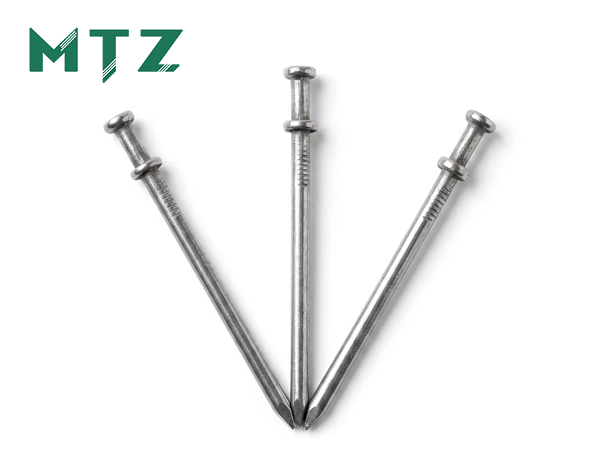
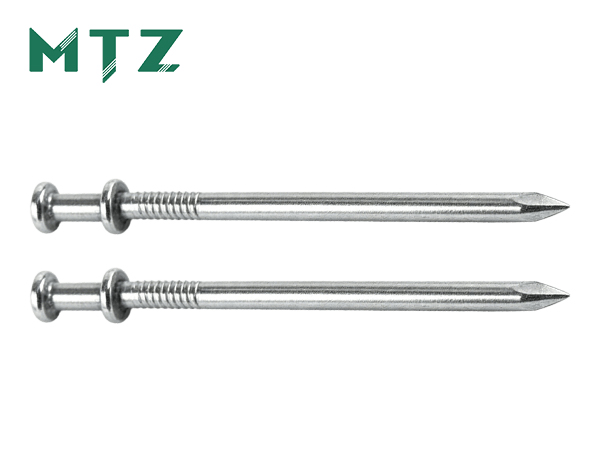 Duplex nails – also called double-headed nails or scaffold nails – have two heads on one shank. The lower head drives flush with the wood. The upper head stays exposed, giving you a solid grip for a claw hammer or crowbar when it’s time to pull it out. You drive it only until the lower head meets the wood. No prying, no chiseling, no damaged lumber.
Mostly used in formwork, temporary bracing, and scaffolding. Also wooden cleats for roofing and any structure that has to come apart after the job is done. Same carbon steel (Q195, Q235). Similar strength. Different geometry.
Duplex Nails vs Common Nails: A Side-by-Side Look
| Feature | Common Nail | Duplex Nail |
| Heads | Single flat head | Two heads (lower for driving, upper for removal) |
| Installation | Drive flush or countersunk | Drive only to lower head; upper stays exposed |
| Removal | Difficult – prying required, damages wood | Easy – claw hammer grips upper head |
| Primary Use | Permanent structures | Temporary construction |
| Typical Applications | Framing, sheathing, structural connections | Concrete formwork, scaffolding, bracing |
| Reusability | Not practical | Can be pulled and reused |
| Penny Sizes | 2d through 60d | 6d through 30d |
The Cost Logic: Labor Over Material
I’ve seen contractors spec common nails for formwork because they’re a few cents cheaper per pound. Then they spend hours on teardown, prying nails that have essentially become permanent fixtures in the wood.
Duplex nails cost slightly more. But the labor savings on removal more than covers it. When you’re tearing down 50 sections of formwork, pulling each nail with one or two hammer swings instead of five or six adds up fast.
On fast-paced formwork projects, crews tend to prioritize removal speed over material cost, especially when reuse of timber is part of the workflow.
Size and Gauge: What to Order
Duplex nails use the same penny system as common nails:
| Penny Size | Length (inches) | Gauge (approx.) | Common Use |
| 6d | 2″ | 11.5 | Light formwork |
| 8d | 2.5″ | 10.5 | General formwork |
| 10d | 3″ | 9 | Standard scaffolding |
| 12d | 3.25″ | 9 | Heavy formwork |
| 16d | 3.5″ | 8 | Heavy scaffolding |
| 20d | 4″ | 6 | Heavy bracing |
| 30d | 4.5″ | 5 | Extra-heavy temporary structures |
Typical job site sizes: 8d, 10d, and 16d.
Most duplex nails have a smooth shank – no rings, no spiral threads. That’s intentional. It makes removal easier. The holding power comes from wood fibers closing around the shank, not from mechanical locking features.
Standards
For commercial projects, duplex nails should meet ASTM F1667 for driven fasteners. For outdoor or treated lumber, specify ASTM A153 hot-dip galvanized coating.
In practice, improper removal of duplex nails can still cause minor surface damage if the upper head is bent during extraction.
When to Use Duplex Nails (And When Not To)
Some contractors try to use duplex nails for everything because they’re easier to remove. That’s a mistake.
Not for:
- Structural framing that stays in place
- Roof sheathing or underlayment
- Load-bearing connections
- Any application where the head needs to be flush or hidden
The upper head stays exposed – it catches on clothing, snags materials, and interferes with finishes. The two-head design also creates a stress point under heavy lateral loads.
Duplex for temporary work. Common for everything else.
For Buyers and Contractors
If the job comes apart – concrete forms, scaffolding, temporary bracing – duplex nails are the right call. They cost a little more per pound, but they save hours on teardown and preserve the lumber for reuse.
 If you’re framing a house or building anything that stays, common nails are what you need.
At MTZ, we manufacture both – duplex nails in 6d through 30d, bright or hot-dipped galvanized, meeting ASTM F1667. Common nails in the full range of penny sizes for structural and framing applications.