Paper vs. Plastic Collated Nails: Which Is Better for Framing?
Introduction
Paper vs plastic collated nails is not simply a choice between two strip materials. For professional framing, the right choice starts with the nailer: approved collation angle, nail diameter, length, head configuration and magazine design. Once those requirements are fixed, paper or plastic becomes a practical purchasing decision.
If a strip looks correct but its angle or head does not match the tool, the result can be feeding problems, misfires or an unusable fastener. That is why paper vs plastic collated nails should be evaluated as a complete nail-and-tool system.
Whether the application is residential framing, sheathing, truss assembly or another high-volume wood construction job, the first check should be the nailer’s approved fastener specification—not the strip material alone.
What Are Paper and Plastic Collated Framing Nails?
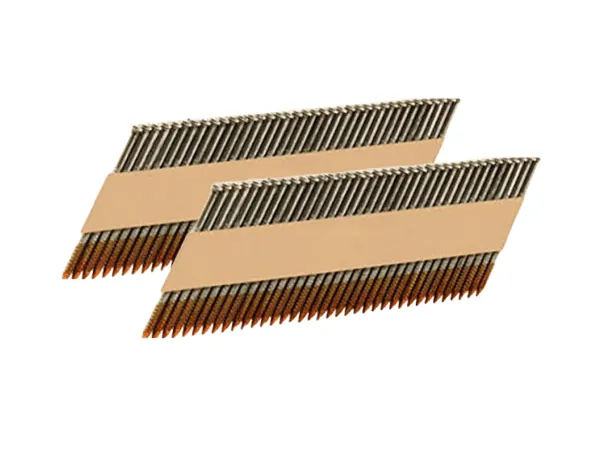
Paper collated framing nails are joined by paper tape, while plastic collated framing nails are held in a plastic strip. Both formats are used in professional framing nailers, but they are not automatically interchangeable.
SENCO currently specifies its F-35XP for 30°–34° paper-tape strip nails, 2″–3½” long and .113″–.148″ in diameter. Its F-35FRHXP is specified for 20°–21° plastic-collated nails, 2″–3½” long and .113″–.131″ in diameter. The listed magazine capacities are 60 and 35 nails respectively. These are model-specific figures, but they show why paper vs plastic collated nails must be matched to the actual tool specification.
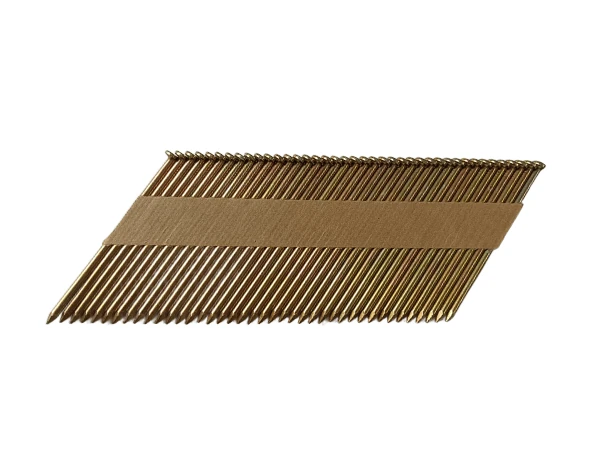
DEWALT provides another clear example. Its DW325PT is a 30° paper-tape framing nailer, while the DW325PL is a 21° plastic-collated model. Their published specifications also differ in loading capacity, shank diameter and nail head configuration.
These are not minor details: paper vs plastic collated nails can behave differently when the strip is loaded into a tool that was designed around another collation geometry.
Paper vs Plastic Collated Nails: What Actually Changes?
For paper vs plastic collated nails, five factors matter most to professional buyers: tool compatibility, head configuration, reload frequency, jobsite debris and moisture exposure.
1. Tool Compatibility
Paper vs plastic collated nails must match the nailer’s magazine angle and feeding system. A 21° plastic strip is not a substitute for a 30° paper-tape strip simply because both are intended for framing.
DEWALT’s specifications illustrate the point: the DW325PT uses 30°–34° paper tape and a 30° clipped-head/full-head configuration, while the DW325PL uses 21° plastic collation and a 21° round head. Nail length and shank diameter ranges also differ.
For paper vs plastic collated nails, the first check should be the nailer’s model number and approved fastener list—not the carton label.
DEWALT’s support documentation makes the same point from a compatibility perspective: some of its pneumatic framing nailers can use glue, paper or plastic-collated nails, but users still need to verify the nail’s angle, gauge and length.
2. Head Configuration
Head style can determine whether a fastener is acceptable for a particular framing application. 21° plastic systems commonly use full-round-head nails, while many 30° paper systems use clipped-head or other head configurations.
SENCO’s current F-35XP compatible range includes 30° paper-tape nails with clipped heads and smooth, ring or screw shanks. Its F-35FRHXP range includes 21° full-round-head plastic-collated nails in smooth and ring shank versions.
This is why paper vs plastic collated nails should not be selected before the required head and shank configuration is known.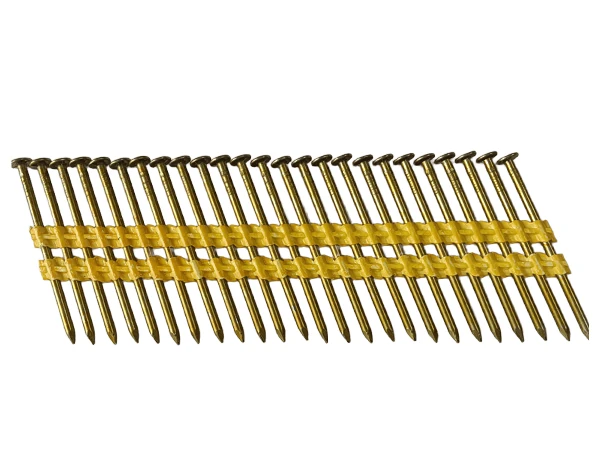 3. Magazine Capacity and Reload Frequency
Magazine capacity is a productivity metric, not a quality metric.
In one current SENCO comparison, the F-35XP carries 60 nails and the F-35FRHXP carries 35. DEWALT lists up to 92 nails for the DW325PT and up to 64 for the DW325PL.
In a production environment, paper vs plastic collated nails are best compared by the complete fastening cycle, not by strip material in isolation.
For high-volume framing, paper vs plastic collated nails should therefore be compared together with the actual nailer capacity. Fewer reloads can matter to workflow, but capacity varies by model.
4. Jobsite Debris
Paper and plastic separate differently after driving. Paper tape leaves paper fragments; conventional plastic systems can leave plastic strip pieces. Some plastic products are specifically designed to reduce this debris.
Paslode has offered a 21° “No Debris” plastic-strip system specifically designed to reduce plastic fragments during use. Its product documentation also specifies a full-round-head configuration and 2″–3½” fastener range for the associated tool.
For paper vs plastic collated nails, the relevant question is what happens to the strip after firing: cleanup, finishing work, worker comfort and local jobsite requirements can all influence the choice.
5. Moisture and Storage
Moisture is one of the clearest practical differences. Paper tape is more vulnerable to moisture than plastic strip, so paper collated nails should be kept dry and protected from prolonged exposure to rain or high humidity.
For coastal or humid supply chains, paper vs plastic collated nails also need to be reviewed from the perspective of packaging and warehouse handling. Carton storage, container transport and warehouse conditions can affect paper collation before the product reaches the end user.
Plastic strip generally tolerates wet handling better, but that does not make every plastic-collated nail suitable for every environment. Corrosion resistance still comes from the nail’s material and finish—not from the plastic collation itself.
Paper vs Plastic Collated Nails: Which Should You Choose?
There is no universal winner. The decision becomes straightforward when the application is matched to the tool.
When the project specification is fixed, paper vs plastic collated nails can be narrowed down quickly by matching the tool, head and shank requirements.
| Requirement | Starting Point | Reason |
|---|---|---|
| 30°–34° paper-tape nailer | Paper | Matches the specified magazine and feeding system |
| 20°–21° plastic nailer | Plastic | Matches the specified magazine and feeding system |
| Full-round head required | Often plastic | Common in 21° systems; verify the nailer |
| Clipped-head configuration required | Often paper | Common in 30° systems; verify the nailer |
| Moisture exposure during handling | Often plastic | Plastic strip is less moisture-sensitive |
| Loose plastic fragments are undesirable | Often paper | Paper tape does not leave plastic strip pieces |
| High-volume repetitive framing | Compare actual capacity | Capacity varies by nailer |
| Structural fastening | Either, if approved | Head, diameter, length, shank and coating matter |
The table is a starting point, not a substitute for the tool manufacturer’s fastener specification. For paper vs plastic collated nails, selection should always follow the approved tool interface.
Can Paper and Plastic Collated Nails Be Used Interchangeably?
Sometimes a nailer manufacturer approves more than one collation type, but interchangeability should never be assumed.
A professional buyer should never approve paper vs plastic collated nails from a product photograph alone; dimensional and compatibility data should be documented.
DEWALT states that some pneumatic framing nailers can use different collation types while still requiring users to check nail angle, gauge and length. Compatibility is therefore model-specific.
Before approving a substitute, verify:
- Nailer model
- Collation angle
- Nail diameter
- Nail length
- Head configuration
- Shank type
- Finish or coating
- Project requirements
For paper vs plastic collated nails, a supplier should be able to provide a compatibility specification rather than simply describing the product as “for framing.”
How Should B2B Buyers Compare Cost?
Carton price alone is not enough. Different SKUs can contain different numbers of nails, even within the same collation type.
SENCO’s current listings show 30° paper-tape SKUs packed at 1,000, 2,500 or 3,100 nails per box, while listed 21° plastic-collated SKUs include 1,000, 2,500 and 5,000-nail boxes depending on specification.
The same principle applies when comparing paper vs plastic collated nails from different manufacturers: compare equivalent specifications before comparing the commercial terms.
For paper vs plastic collated nails, the basic purchasing calculation is:
Cost per nail = Carton cost ÷ Nails per carton
For international B2B purchasing, a more useful measure is:
Landed cost per usable nail = (Product cost + freight + applicable handling/packaging costs) ÷ usable nail quantity
 This avoids a common purchasing mistake: comparing two carton prices when the carton quantities are different.
For paper vs plastic collated nails, a lower carton figure does not necessarily mean a lower fastening cost. Nail count, diameter, length, coating, packaging and freight all affect the actual purchasing result.
Tool wear should be handled with the same discipline. There is no sound basis for claiming that paper or plastic collation universally causes more driver or nosepiece wear. Tool condition, fastener dimensions, compatibility, operating conditions and maintenance all affect service life.
What Should Be Included in a B2B Specification?
For importers, distributors and contractors, paper vs plastic collated nails should be specified at SKU level. Paper vs plastic collated nails are easier to audit when each SKU has a defined compatibility record.
A practical purchase specification should include:
- Collation: paper tape or plastic strip
- Angle: 20°–21° or 30°–34°, according to the nailer
- Diameter
- Length
- Head type
- Shank type
- Point type
- Finish or coating
- Nails per strip, where applicable
- Nails per carton
- Compatible nailer models
SENCO’s current fastener listings identify length, point, head, finish, coating, collation and box count at SKU level.
For a distributor buying multiple sizes, “30° paper framing nails” is a product category, not a complete purchasing specification. Paper vs plastic collated nails become much easier to qualify when every SKU is defined against the same checklist.
Final Takeaway
Paper vs plastic collated nails is ultimately a tool-compatibility and application decision. Paper systems are commonly associated with 30°–34° nailers, while plastic systems are commonly associated with 20°–21° nailers. These are common system configurations, not universal rules; the individual nailer specification always takes priority.
For paper vs plastic collated nails, the safest B2B process is simple: identify the nailer, confirm its approved fastener specification, define the required nail configuration, and compare cost per nail or landed cost per usable nail.
Both paper collated framing nails and plastic collated framing nails can be effective professional fastening solutions. The better choice is the system that matches the tool and application—not simply the strip material.